-(2).png)
What Is Intensive Trauma Therapy - And How Does It Work?
January 1st, 2026
Summary
When it comes to treating trauma, many people assume therapy must take months or even years. But recent research and clinical practice are challenging that idea with intensive trauma therapy showing powerful results in just days or weeks. So, what exactly is intensive trauma therapy? And why does it seem to work so well when treating PTSD and C-PTSD? This blog breaks it down for you.
How did intensive therapy emerge as a treatment option?
Traditional models of care normally operate on weekly or fortnightly sessions with a qualified mental health professional, which can be supplemented by a psychiatrist who might prescribe medication to manage some symptoms, as deemed clinically appropriate.
Even though trauma diagnosis like PTSD and C-PTSD can be successfully treated with traditional models of care, there is room for improvement.
A meta-analysis of psychotherapy for PTSD conducted in 2005 by Bradley et al. found that most patients with PTSD treated with psychotherapy showed improvement in randomised controlled trials. Despite improvements, it was noted that exclusion criteria can ‘skew’ the data and that post treatment, “the majority of patients continue to have substantial residual symptoms” (Bradley et al., 2005).
Intensive treatments have emerged over the previous 15-20 years to increase retention (lowering dropout rate) and to provide more rapid relief from symptoms (Van Woudenberg et al, 2018).
The dropout rate for intensive therapy is less than 3%, which is substantially lower than the 22.2% reported for weekly trauma focused sessions (Kline et al., 2018).
Research suggests that there are multiple factors that can contribute to sub-optimal treatment outcomes. These include a lack of treatment intensity and non-adherence to gold-standard treatment modalities such as Eye Movement Desensitisation and Reprocessing (EMDR) and issues like ‘therapist drift’ (Grimmett & Galvin, 2015; Waller, 2009; Waller & Turner, 2016).
For these reasons, traditional treatments do not always achieve projected or desired outcomes. The term ‘treatment resistant’ emerged in major depression to describe situations where at least two treatment types had not resolved the condition (Sippel et al., 2018). Treatment resistance in PTSD is less clearly defined, however common themes include remaining symptomatic following six or more months of counselling and six or more months of SSRI treatment at the maximum tolerable dosage (Fonzo., Federchenco, & Lara., 2020).
Regardless of the definition, intensive therapy has emerged as an extremely promising method for treating clients who have not responded to other methods of therapy.
What does 'Intensive Therapy' mean?
Intensive therapy is typically a short-term, high-frequency treatment approach that delivers multiple therapy sessions over a condensed period, often spanning days like our 4-Day Intensive Trauma Program, or weeks.
Instead of one session per week, clients may receive two or more sessions per day. Some intensive models focus on single treatment modalities while others combine different evidence-based techniques like:
- Prolonged Exposure (PE) Therapy
- EMDR or EMDR 2.0
- Cognitive Processing Therapy (CPT)
- Psychoeducation
- Mindfulness
The goal is to help clients process trauma rapidly, reduce avoidance, and break through symptoms in a focused, supportive environment.
The Psytrec Model
Psytrec are a Dutch clinic who are world leaders in trauma research and have been particularly influential in developing intensive models of trauma therapy. Psytrec have trialled several models of intensive therapy which combine Prolonged Imaginal Exposure Therapy (PE) and Eye Moment Desensitisation and Reprocessing 2.0 (EMDR 2.0), experimenting with the number of sessions per day and the order of the therapies.
Key findings of Psytrec’s research include:
- Sequence matters: delivering PE sessions prior to EMDR resulted in greater treatment outcomes and with patients reporting a better experience (Van Minnen et al. 2020).
- Combining PE and EMDR 2.0 was significantly more effective than using either therapy on their own (Van Woudenberg et al., 2018).
- Having several therapists work with the patient over the course of the intensive (therapist rotation) created greater adherence to therapeutic methods (Van Minnen et al., 2018).
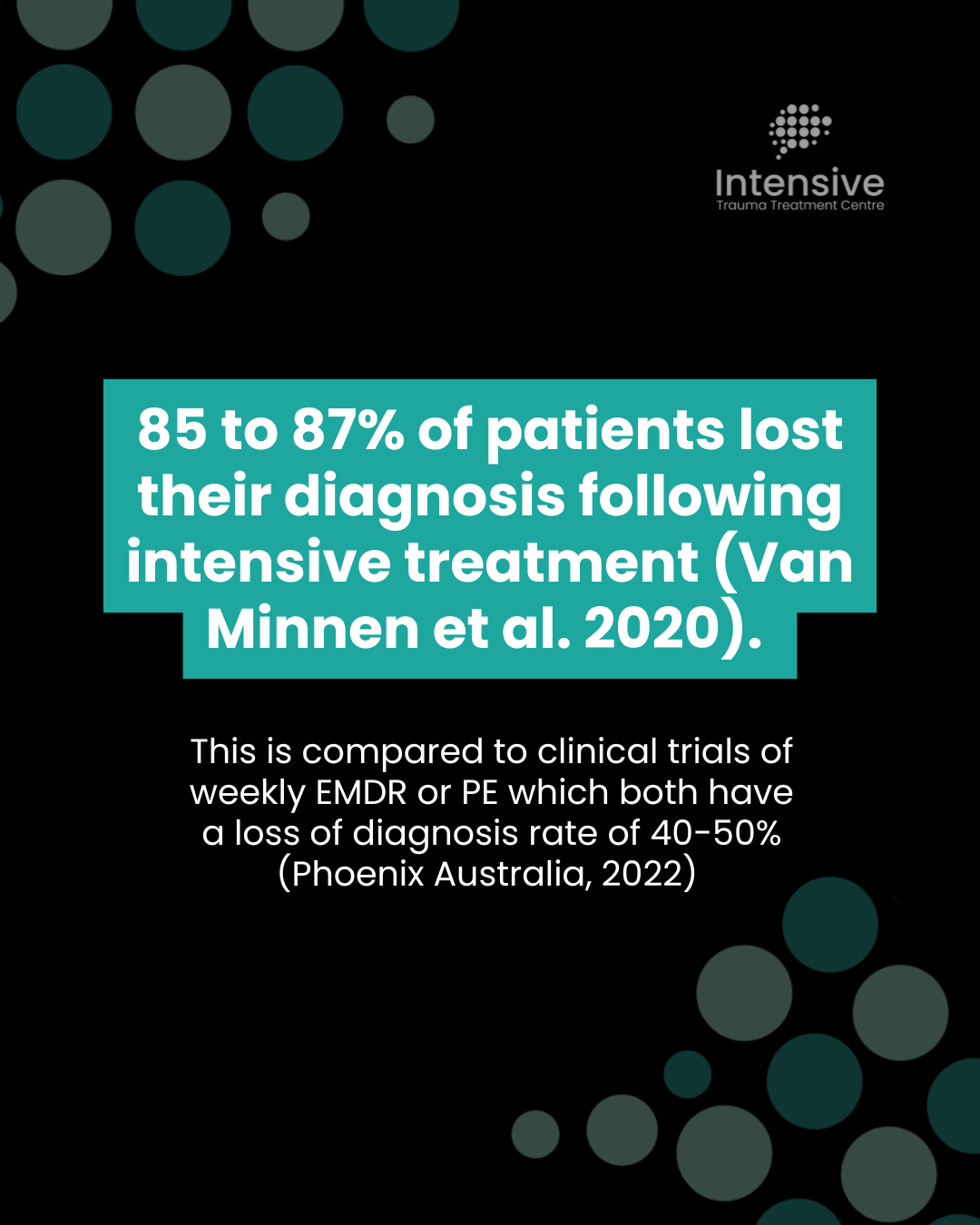
- More than 8 in 10 clients who completed this model of intensive therapy experienced a symptom reduction significant enough to result in a loss of diagnosis (Van Minnen et al., 2020).
The ITTC Program is based off Psytrec’s most intensive model, delivering 24 hours of ‘active’ therapy across four consecutive days, using PE and EMDR 2.0 in the optimal order, and using therapist rotation.
What are some common myths about intensive trauma therapy?
There are some common misconceptions that can arise from both clients and their care teams when the subject of intensive therapy is first discussed.
| Misconception | Explanation |
|---|---|
| 1. Stabilisation is required prior to treatment | Traditional thinking suggests that clients require a long period of symptom stabilisation prior to treatment, and this is referenced in many guidelines for treating Complex PTSD. However, de Jongh et al. (2016) found that a stabilisation phase did not enhance outcomes for clients with C‑PTSD. In some cases, stabilisation can even be counterproductive by delaying access to evidence‑based treatments. Provided there is no acute suicidal ideation, most people can move straight into intensive therapy after a thorough intake and planning process. |
| 2. The treatment will be too intense | The ITTC uses the most intensive Psytrec‑validated protocol: 24 total hours of therapy delivered across a four‑day block (six hours per day). While this can be tiring, clients usually find the rapid progress highly motivating. Psytrec has treated thousands using this model, and their very low dropout rates indicate that clients from diverse backgrounds can manage the intensive format. |
| 3. Therapist rotation will undermine rapport |
Long-term, relationship‑focused therapy is valuable but not the foundation of intensive treatment. In intensive models, rapport still forms naturally but is not the central goal. Therapist rotation—typically involving 2–4 clinicians per client—was developed by Psytrec to reduce avoidance of key treatment techniques (Van Minnen et al., 2018) and to enhance outcomes by:
* Minimising emotional identification with the client's avoidance * Matching clinicians' strengths to client needs * Maintaining continuity regardless of scope/availability Rotation keeps both therapists and clients accountable to evidence‑based methods. Each clinician contributes their unique skillset, and the team works together with the client toward clearly defined, time‑bound goals. This strengthens motivation and reduces avoidance. |
What does the research say on the success of intensive trauma treatment?
Who is eligible for Intensive Trauma Treatment?
Intensive therapy can be helpful for:
- People with severe or long-standing PTSD or cPTSD
- People suffering from adjustment disorder
- Those who have not reached projected or desired outcomes from weekly therapy
- Those seeking rapid results (e.g., military, emergency workers, survivors of disaster or violence)
- Clients with limited time availability (e.g., traveling for therapy)
Final thoughts
Intensive trauma treatment is not just a trend, it is a clinically supported option that’s changing how we think about trauma treatment. By delivering evidence-based therapies in an intensive format, clients can often achieve faster, deeper healing than in traditionally paced sessions.
If you or someone you know is struggling with trauma (PTSD, C-PTSD, adjustment disorder) and wants relief sooner, not later, intensive trauma therapy might be a life-changing path forward
References
- Australian Guidelines for the Prevention of and Treatment of Acute Stress Disorder, Posttraumatic Stress Disorder and Complex PTSD (2020). Developed by Phoenix Australia.
- Bradley, R., Greene, J., Russ., E., Dutra, L., & Westen, D. (2005). A Multidimensional Meta-Analysis of Psychotherapy for PTSD. American Journal of Psychiatry, 162(2), 214-227.
- De Jongh, A., Resick, P. A., Zoellner, L. A., van Minnen, A., Lee, C. W., Monson, C. M., Foa, E. B., Wheeler, K., Broeke, E. T., Feeny, N., Rauch, S. A., Chard, K. M., Mueser, K. T., Sloan, D. M., van der Gaag, M., Rothbaum, B. O., Neuner, F., de Roos, C., Hehenkamp, L. M., . . . Bicanic, I. A. (2016). Critical analysis of the current treatment guidelines for complex PTSD in adults. Depression and Anxiety, 33(5), 359-369.
- Fonzo, G., Federchenco, V., & Lara, Alba. (2020). Predicting and Managing Treatment Non-Response in Posttraumatic Stress Disorder. Current Treatment Options in Psychiatry, 7, 70-87. doi: 10.1007/s40501-020-00203-1
- Grimmett, J., & Galvin, M. D. (2015). Clinician Experiences with EMDR: Factors influencing continued use.Journal of EMDR Practice and Research(1), 3-16.
- Kline, A. C., Cooper, A. A., Rytwinski, N. K., & Feeny, N. C. (2018).Long-term efficacy of psychotherapy for posttraumatic stress disorder: A meta-analysis of randomized con-trolled trials. Clinical Psychology Review, 59, 30–40
- Sippel, L., Holtzheimer, P., Friedman, M., & Schnurr, P. (2018). Defining Treatment-Resistant Posttraumatic Stress Disorder: A Framework for Future Research. Biological Psychiatry, 84(5),
- Van Minnen, A., Henriks, L., De Kliene, R., Hendriks, G-J., Verhagen, M., & De Jongh. (2018). Therapist rotation: a novel approach for implementation of trauma-focused treatment in post-traumatic stress disorder. European Journal of Psychotramatology 9(1), doi: 10.1080/20008198.2018.1492836.
- Van Minnen, A., Voorendonk, E. M., Rozendaal, L., De Johgh A. (2020). Sequence Matters: Combining Prolonged Exposure and EMDR Therapy for PTSD. Psychiatry Research, 290. DOI: 10.1016/j.psychres.2020.113032.
- Van Woudenberg et al. (2018). Effectiveness of an intensive treatment programme combining prolonged exposure and eye movement desensitization and reprocessing for severe post-traumatic stress disorder. European Journal of Psychotraumatology, 1. https://doi.org/10.1080/20008198.2018.1487225
- Waller, G. (2009). Evidence-based treatment and therapist drift. Behaviour Research and Therapy, 47(2), 119-127.
- Waller, G., & Turner, H. (2016). Therapist drift redux: Why well-meaning clinicians fail to deliver evidence-based therapy, and how to get back on track. Behaviour Research and Therapy, 77, 129-137.